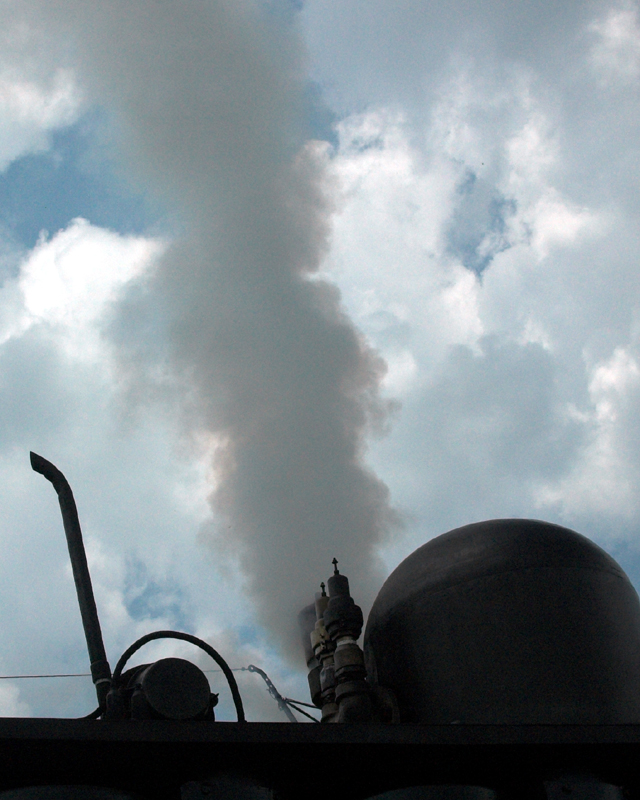
In 1866, George W. Richardson, an engineer in the employ of the Troy and Boston Railroad, patented a spring loaded safety valve
in which the steam, after leaving the ground joint, passed into an annular chamber, surrounding and attached to or forming part
of the head of the valve, where it exerted additional pressure to raise the valve from its seat against the increasing tension
of the spring. The passage way for the steam from this annular chamber to the atmosphere was restricted, and upon this depended
the result obtained by the valve. These results were such as never had been obtained before in the use of the safety valve. Of
this there has never been any question. Applied to a boiler, Richardson's valve would open sharply at the exact pressure at which
it was set, blow rapidly and after reducing the pressure in the boiler by about two pounds close as abruptly as it opened,
accomplishing this under ordinary conditions in a few seconds of time. Comparison was hardly possible between this valve and
other safety valves in use at that time. On locomotives and other quick steaming boilers, the old safety valve served little
other purpose than to warn the attendant that the pressure was getting dangerously high, when they took means to assist the
safety valve in reducing it. This was particularly true of boilers under motion, where for obvious reasons the valves must be
spring loaded, and the spring opposed by increased tension as soon as the valve began to leave its seat ; but it was measurably
true of safety valves as applied to all classes of boilers. One of Richardson's valves, of only a fractional part of the area
of the old valve, would prevent the possibility of increasing the pressure in a boiler, even with the hardest firing, when the
old valve would permit the accumulation of a dangerous pressure under ordinary firing. This was repeatedly demonstrated and is
of interest as showing what Richardson gave to the public in his valves. By regulating the structure between the annular chamber
and the atmosphere, by which the pressure in the chamber (always of course less than the boiler pressure) would be correspondingly
regulated, the valve could be made to close upon any desired reduction of boiler pressure, as little as one-half pound per
square inch with boiler pressure of 125 pounds. Richardson's valve permitted keeping the pressure in a boiler substantially
constant, effectually avoiding all danger of disaster by high pressure and loss from excessively reducing the pressure through
the safety valve. Richardson's valve almost immediately went into extended use, especially on locomotives. From the startling
way it opened and closed railroad men called it a "pop" valve, a name it still retains. The introduction of Richardson's valve
led to litigation, which is historical and has formed a precedent in many patent cases that have no relation to safety valves.
The Richardson safety valve, having obtained quick popular ity, attempts to evade the patents followed as a matter of course.
The basis of evasion was the claim that, previous to the Richardson invention, efforts had been made, particularly in Great
Britain, to construct a valve that should do what Richardson's valve accomplished and that patents had been granted upon several
such valves in England, and that one of the English inventors had patented his valve in this country. Nothing, generally
speaking, was known about these valves, because, utterly failing in their purpose, they never passed beyond the experimental
stage. Several of them would prevent the accumulation of steam beyond the point at which they were set to blow, but having
begun to blow they would continue it until the boiler pressure was reduced from twenty to fifty per cent. This rendered them
not only valueless, be cause they would reduce the pressure below that required to do the work, but extremely wasteful of
steam and dangerous in that they would submit the material of the boiler to sudden and damaging changes of temperature.
These valves possessed one feature in common with Richardson's, viz.: a surface for the steam to act upon after leaving
the grooved joint. But they lacked the structure that should confine the steam just sufficiently to overcome the increased
tension of the spring, but not sufficiently to prevent the spring from promptly closing the valve upon a slight reduction
of the pressure in the boiler. So far as utility as a safety valve adapted for use on a boiler furnishing steam regularly,
as for a steam engine, was concerned, valves constructed after these English patterns were just about as valuable as a plug
so fastened in a boiler shell that if a certain pressure is exceeded it will blow out and empty the boiler of steam. It was
soon found by those who sought to evade Richardson's patents that, by additions in the light of his achievements, valves
constructed after some of the rehabilitated English patents could be made to work with reasonable satisfaction. Not long
after the introduction of Richardson's valve, E. H. Ashcroft began to manufacture safety valves under a re-issue of Naylor's,
an English patent, claiming that Richardson's was subordinate to Naylor's. Other makers of safety valves did practically
the same thing. One of the principal infringers of the Richardson patent was sued and the lower courts decided that the
English patent rendered the Richardson invention invalid. The Consolidation Safety Valve Company, of which Charles A.
Moore was president, had secured control of the Richardson patents and they appealed the case to the Supreme Court of
the United States, where the decision of the lower court was reversed. The opinion of the Supreme Court, as delivered
by Justice Blatchford, has been a palladium to real inventors. I can give only brief extracts from the opinion. He says,
speaking of the English patents adduced against Richardson's original patent: "It may be generally said that there never
were in their day and before the date of that patent, or of Richardson's in vention, known or recognized as producing
any such result as his apparatus of that patent produced. Likenesses to them in physical structure to the apparatus of
Richardson in important particulars may be pointed out, but it is only as the anatomy of a corpse resembles that of the
living being. The prior structures never effected the kind of result attained by Richardson's apparatus, because they
lacked the thing which gave success. . . . Taught by Richardson and by the use of his apparatus, it is not difficult
for skilled mechanics to take the prior structures and so arrange them as to produce more or less the beneficial results
first made known by Richard son, but prior to 1866, though these old patents and their descriptions were accessible, no
valve was made producing any results. . . .
"It appears to have been easy enough to make a safety valve which would
relieve the boiler, but the problem was to make one which, while it opened with increasing power of the steam against
the increasing resistance of a spring, would close suddenly and not gradually by the pressure of the same spring
against the steam. This was a problem of the reconciliation of antagonisms which so often occurs in mechanics, and
without which practically successful results are not obtained. What was needed was a narrow stricture to hold back
the escaping steam and secure its expansion force inside the lip and thus aid the direct pressure of the steam from
the boiler in lifting the valve against the increasing tension of the spring, with the result that, after only a small
but a sufficient reduction in the boiler pressure, the compressed spring would, by its very compression, obtain the
mastery and close the valve quickly. This problem was solved by Richardson and never before. "Richardson's invention
brought to success what prior inventors had essayed and partly accomplished. He used some things which had been used
before, but he added just that which was necessary to make the whole a practically valuable and economical apparatus.
The fact that the known valves were not used, and the speedy and extensive adoption of Richardson's valve, are facts
in harmony with the evidence that his valve contains just what the prior valves lacked, and go to support the conclusion,
at which we have arrived on the question of novelty. When the ideas necessary to success are made known, and a structure
embodying these ideas is given to the world, it is easy for the skilled mechanic to vary the form by mechanism which
is equivalent, and is, therefore, in a case of this kind, an infringement."'